SWEAT SCIENCE
Why Carbs Are So Important for Recovery
New data shows that, unlike a car, you can’t perform well with a half-full fuel tank
Alex HutchinsonOct 6, 2022
Outside's long reads email newsletter features our strongest writing, most ambitious reporting, and award-winning storytelling about the outdoors. Sign up today.
Back in 2010, a journal article in PLOS Computational Biology caused a stir in the running world. It offered a comprehensive model of how you store carbohydrates in your body and how quickly you burn them during a marathon, in order to calculate how much extra you need to consume. “Marathon runners need never ‘hit the wall’ again,” media reports enthused.
The basic assumption behind this model was that you can run happily when you’ve got carbs in the tank, but you’ll grind to a halt—or at least hit the wall and slow down dramatically—when you run out. Of course, there are lots of other factors to consider, like microscopic muscle damage that accumulates during long runs. But some scientists have argued that there’s a more fundamental problem with this assumption, which is that you start getting tired long before your carbohydrate fuel tank is empty—a counterintuitive idea, equivalent to your car automatically slowing down when the tank is still half-full.
This is the idea addressed by a new study in Medicine & Science in Sports & Exercise, from a team of researchers in Denmark led by Jeppe Vigh-Larsen of Aarhus University. In the world of muscle physiology, Scandinavian researchers are famous for their rigorous experiments, and this one is no exception: the study’s volunteers underwent a series of protocols that included four muscle biopsies—that is, snipping out a piece of thigh muscle for detailed analysis—in one day. The payoff is a remarkable look at what’s happening inside your muscles as you exhaust and then recharge them.
After a bunch of initial testing, the volunteers did an exhausting interval workout on exercise bikes to deplete the glycogen (i.e. stored carbohydrate) in their leg muscles. Afterwards, they rested for five hours while consuming high-carbohydrate recovery bars and drinks, or placebo versions with low carbohydrates. Then they did more exercise tests: six sets of five-second all-out sprints, plus a two-minute test at fixed intensity to measure perceived exertion.
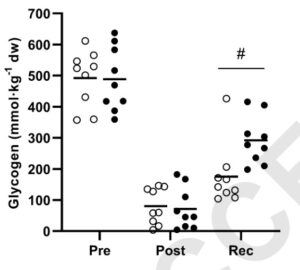
Here’s what the muscle biopsies revealed about the amount of carbohydrate stored in the subjects’ thigh muscles before the interval workout (Pre), after the interval workout (Post), and after five hours of recovery, right before the all-out sprints (Rec). Open circles are the placebo group, filled circles are the high-carb group:
 (Illustration: Medicine & Science In Sports & Exercise)
As planned, the interval workout drained the leg muscles of carbohydrate. The high-carb drinks and bars partly restored those lost carbohydrates; the low-carb group also replenished some of those stores, but to a lesser extent.
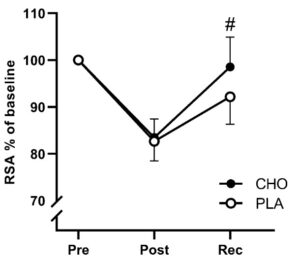
Here’s how the all-out sprints went for the high-carb (CHO) and placebo (PLA) groups, expressed as a percentage of their baseline repeated sprint ability (RSA):
 (Illustration: Medicine & Science In Sports & Exercise)
Their sprinting suffered after the exhausting interval workout, which is no surprise. Five hours later, it had partly recovered—but not as much in the placebo group as in the high-carb group.
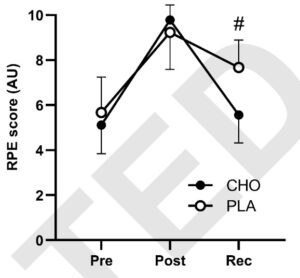
Similarly, here’s the rating of perceived exertion (RPE), on a scale of 1 to 10, for the two-minute ride at a predetermined power. It got harder when they were tired and then easier after they recovered—but again with greater recovery for the high-carb group.
 (Photo: Medicine & Science In Sports & Exercise)
Overall, the results agree with previous data suggesting that performance suffers when your muscles have less than about 250-300 mmol/kg of carbohydrate, which is somewhere around half-full. Why does this happen? The paper goes pretty deep into the intricacies of muscle physiology, but there are a couple of points that stood out to me.
The first point is that there’s a difference between how much carbohydrate is available overall in a muscle versus what’s available to an individual muscle fiber. If you’ve got 250 mmol/kg out of a maximum capacity of 500 mmol/kg, your muscles are half-full. But that might mean that some fibers are mostly full while others are mostly empty. And indeed, that’s what the researchers found: in the low-carb group, 19 percent of individual slow-twitch fibers and 4 percent of fast-twitch were depleted to less than 20 percent of their initial carb levels. In comparison, no individual fibers were that depleted in the high-carb group. When you do all-out exercise, like six-second sprints or sprinting at the end of a long race or a soccer game, you need all your muscle fibers to fire. If some are empty, then your performance will be compromised even if there’s carbohydrate in the fiber next door.
And you can even zoom in a little further, to consider how glycogen is stored within muscle fibers. There are three main places where you’ll find glycogen in a muscle fiber, called (since you asked) subsarcolemmal, intermyofibrillar, and intramyofibrillar. The last one, known as intra glycogen for short, has been linked in previous research to how well muscle fibers contract. Sure enough, in the low-carb group, roughly half the individual fibers were depleted to less than 20 percent of their baseline levels of intra glycogen—and each individual’s level of intra glycogen depletion was correlated with how much worse they did on the repeated sprint test. That suggests that a muscle fiber may be compromised even if it has plenty of glycogen left, if that glycogen isn’t in the right place within the fiber.
All of this biochemistry is in service of a simple point, which is that there’s a big grey area between the extremes of being fully fueled and bonking. Most of the time I don’t really worry about this, because I train once a day, and glycogen levels generally bounce back within about 20 to 24 hours as long as you’re eating a reasonable diet, without needing to stress about post-workout refueling windows and details like that. But there are times when it matters. For example, I typically play basketball on Friday evenings, then meet friends for a tempo run on Saturday mornings. The data suggests that my legs will still be partly carb-depleted the next morning, so I refuel very aggressively when I get home from my basketball game. I probably can’t get the overall tank back to full, but—trust me—I need as many individual fibers as possible to be firing.
For more Sweat Science, join me on Twitter and Facebook, sign up for the email newsletter, and check out my book Endure: Mind, Body, and the Curiously Elastic Limits of Human Performance.
Filed to: Endurance Training
Recovery
ScienceLead Photo: Flamingo Images/Stocksy
Read this next
The Future of Strength Training
By: Alex Hutchinson
The Future of Strength Training
By: Alex Hutchinson
There’s New Evidence That Collagen Might Help Your Tendons
By: Alex Hutchinson
How Sports Psychologists Define Mental Toughness
By: Alex Hutchinson
HealthTraining & Performance
SWEAT SCIENCE
There’s New Evidence That Collagen Might Help Your Tendons
A new study tests the idea that, with the right building blocks, connective tissue can repair itself after all
“We can mold the muscles, you see,” says Bruce Denton, the wizened 1970s guru in John L. Parker Jr.’s Once a Runner. “We can strengthen the mind, temper the spirit, make the heart a goddamn turbine. But then a strand of gristle goes pop and presto you’re a pedestrian.” It was true then and it’s still true now: tendons and ligaments are the athlete’s Achilles heel, crucial to movement but vulnerable to overuse and (unlike muscles) mostly inert in response to attempts to strengthen them.
Back in 2019, I wrote about a new-ish idea that was circulating among elite athletes and their trainers, the brainchild of UC Davis molecular biologist Keith Baar. Tendons and ligaments are mostly made of up collagen. Lab experiments with engineered ligaments suggested that the availability of certain key components of collagen, like the amino acid proline, could ramp up the repair and synthesis of new collagen in connective tissue. Collagen supplements have been around for a long time, but Baar had specific ideas about the type of exercise that tendons and ligaments respond to and the form of collagen that would be best to supplement with. He used gelatin, the same stuff found in Jell-O.
The initial work from Baar and his collaborators was intriguing but far from definitive. Then the pandemic hit. The pace of follow-up research has been slow, but a few results have begun to appear—including a newly published study in the journal Frontiers in Physiology from a group at Liverpool John Moores University led by Robert Erskine. In elite female soccer players, they find a big improvement in tendon stiffness—which is a good thing—after taking collagen supplements three times a week.
The study involved 17 players from the under-21 squad of a Football Association Women’s Super League team. Half of them were assigned to take 30 grams of hydrolyzed collagen (they used GBR Nutrition’s Collagen Liquid) three times a week immediately after training. The control group took a calorie-matched placebo drink. Each group also took 500 milligrams of vitamin C, which is thought to be necessary for the body to use the collagen.
The training was a mix of on-field soccer practice, leg strengthening exercises, and plyometrics, as per usual, rather than following a special exercise program. The properties of the patellar tendon, which connects the kneecap to the shin bone and is a common site of injury for female soccer players, were measured before and after with ultrasound and strength tests.
The result was an increase in tendon stiffness. You can think of tendons as elastic bands: the stiffer they are, the harder they are stretch, and the more energy they can store. Stiffer tendons, for example, are associated with better running economy, because they recycle more energy from stride to stride. Here’s the stiffness data, showing how much force it takes to stretch the tendons. In the collagen group, stiffness makes a big jump from before (PRE COL) to after (POST COL) training. In the placebo group, the change in the before (PRE PLA) and after (POST PLA) values is much smaller:
 (Illustration: Frontiers In Physiology)
The collagen group’s 18-percent gain in stiffness is significantly bigger than the placebo group’s 8-percent gain. In contrast, there were no differences in the size or cross-sectional area of the tendon, which suggests that the extra collagen improved the microscopic structure of the tendon. There were also no differences in leg strength.
Other recent studies have also bolstered the case for collagen supplementation—but each in slightly different ways, strangely. Last year, Dana Lis and her colleagues in Keith Baar’s UC Davis group published results suggesting that pre-workout collagen plus vitamin C enhances squat and jump performance, but without a significant change in leg stiffness. Also in 2022, Simon Jerger of the University of Freiburg and his team found that daily collagen supplements did boost tendon cross-sectional area, but didn’t improve tendon stiffness more than the placebo group.
All this is a little confusing, and Erskine and his colleagues spend some time in their paper coming up with possible explanations for why each study seems to produce different results. The study protocols were different, so it’s not totally crazy that the results differ. In fact, the positive results from different dosing and exercise protocols are in some sense encouraging, since it implies that you don’t need to follow one specific magical protocol to get the benefits.
But the lack of uniformity should also give us pause. If there’s one thing we know about supplement research, it’s that if you measure enough outcomes, every study finds improvement in at least one. The collagen research, from what I can see, is built on the foundations of good theoretical and basic lab work—but I don’t think its real-world benefits are proven yet.
Still, it’s worth recalling the prevailing orthodoxy, which is that tendons and ligaments are pretty much inert under normal conditions. That’s one of the reasons they heal so slowly—if ever—when you injure them. So anything that can help strengthen them or improve their properties is a big deal, both for prevention and rehab. It’s clear that the details still need to be worked out, but if studies like this one keep accumulating, it will be good news for all of us.
http://www.fasebj.org/content/early/2013/02/11/fj.12-225599.abstract


 Articles

