vendredi 30 mars 2018


Caloric restriction
 |
| 10.1001/jama.295.13.1539 |
Yes, CR leads to weight loss that's a good thing for those who doubt.
But, CR is a proportional tool for WL. More is better. And that's we intuitively know even if it is difficult to implement in the present affluent environment.
 |
| 10.1001/jama.295.13.1539 |
Moins de dommages au niveau de l'ADN.
jeudi 29 mars 2018
Cooling muscles and glycogen resynthesis
 |
| https://physoc.onlinelibrary.wiley.com/doi/pdf/10.1113/JP274870 |
mardi 27 mars 2018
Brain dysnutrition
We are facing a brain dysnutrition.
Lack of foods from sea and lakes means a high W6/W3 ratio and even a higher W6/LCW3PUFA ratio, this is not appropriate for newborns and children brain (https://www.youtube.com/watch?v=JmEwAf1aEcQ&feature=youtu.be).
Secondly a high consumption of high GI carbs which are clearly deleterious for the brain (https://link.springer.com/article/10.1007%2Fs00394-016-1229-6). This lead to hyperactivity in children and depression in adults (https://www.ncbi.nlm.nih.gov/pubmed/28662133).
Third, the non-evidence based low-fat diet.
It is not clearly proven but the low-fat diet is not good for neurons and especially for stroke nor neurodegenerative diseases.
Fourth, some other choices do more harm, like veganism, transfats and poor content in micronutrients for those who consume mainly processed foods (https://www.sciencedirect.com/science/article/pii/S0889159118300023?via%3Dihub).
Lack of foods from sea and lakes means a high W6/W3 ratio and even a higher W6/LCW3PUFA ratio, this is not appropriate for newborns and children brain (https://www.youtube.com/watch?v=JmEwAf1aEcQ&feature=youtu.be).
Secondly a high consumption of high GI carbs which are clearly deleterious for the brain (https://link.springer.com/article/10.1007%2Fs00394-016-1229-6). This lead to hyperactivity in children and depression in adults (https://www.ncbi.nlm.nih.gov/pubmed/28662133).
Third, the non-evidence based low-fat diet.
It is not clearly proven but the low-fat diet is not good for neurons and especially for stroke nor neurodegenerative diseases.
Fourth, some other choices do more harm, like veganism, transfats and poor content in micronutrients for those who consume mainly processed foods (https://www.sciencedirect.com/science/article/pii/S0889159118300023?via%3Dihub).
 |
| https://onlinelibrary.wiley.com/doi/pdf/10.1002/bdr2.1173 |
Un fake sur le régime paléo
“Ces produits sont jugés trop « modernes » en raison des colorants, des conservateurs et autres produits chimiques qu’ils contiennent.“
Quand j’ai lu cela j’ai stoppé !
Cette question des pesticides n’a rien à voir avec les légumineuses ! Ah ah...
https://sohealthy.fr/zoom-regime-paleo/
A oublier
Quand j’ai lu cela j’ai stoppé !
Cette question des pesticides n’a rien à voir avec les légumineuses ! Ah ah...
https://sohealthy.fr/zoom-regime-paleo/
A oublier
lundi 26 mars 2018
Do you know trehalose? And clostridium difficile?
Trehalose is added in a lot of processed "food", products and so on.
https://www.nature.com/articles/nature25178
https://www.nature.com/articles/nrmicro.2018.2
https://www.nature.com/articles/152414a0
Trehalose
What is trehalose?
Trehalose is a sugar, a disaccharide composed of two glucose molecules joined by an alpha-alpha (1,1) glycosidic bond .
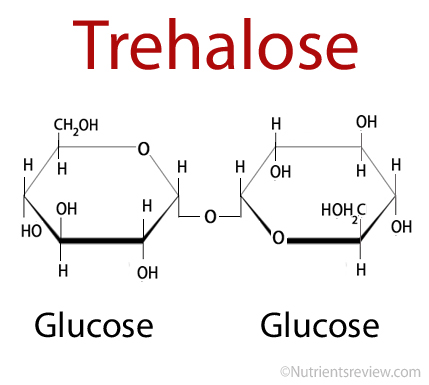
Picture 1. Trehalose structural formula
Nutrition Facts for Trehalose
Calories per gram = 4 [3]
Glycemic index (GI) = 72 (high) [16-p.9]
Sweetness, relative to sucrose = 45% [1]
Net carbohydrates = 100%
Trehalose Sources
Trehalose occurs naturally in small amounts in mushrooms, honey, lobsters, shrimps, certain seaweeds (algae), wine, beer, bread and other foods produced by using baker’s or brewer’s yeast .
As a food additive, trehalose is artificially produced from corn starch using several bacterial enzymes such as alpha-amylase, obtained from Bacillus licheniformis, and isoamylase from Pseudomonas amyloderamosa . Trehalose is heat stable and preserves the cell structure of foods after heating and freezing, so it is used as a food texturizer and stabilizer in dried foods, frozen foods, nutrition bars, fruit fillings and jams, instant noodles and rice, white chocolate, sugar coating, bakery cream, processed seafood and fruit juices .
Trehalose Function in the Human Body
Trehalose is a source of energy – it can provide about 4 Calories per gram, about the same as sucrose .
Trehalose Safety
In the EU [5] and Australia [3], trehalose is considered a novel food – a food that does not have a long-term history of safe use. Trehalose as a food additive is safe to use; it is Generally Recognized As Safe (GRAS) by the U.S. Food and Drug Administration (FDA). Trehalose is approved and commonly used in Japan, Taiwan and south Korea; it is also approved in the EU, Australia and New Zealand [7].
According to some laboratory studies published in Nature in January 2018, trehalose stimulates the growth of certain strains of Clostridium difficile bacteria. These bacteria can cause severe inflammation of the colon, especially in the patients treated in hospitals. In one study in mice, dietary trehalose increased the severity of the infection caused by C. difficile. More studies are needed to find out if trehalose increases the risk and severity of the infection in humans.
https://www.nature.com/articles/nature25178
https://www.nature.com/articles/nrmicro.2018.2
https://www.nature.com/articles/152414a0
Trehalose
What is trehalose?
Trehalose is a sugar, a disaccharide composed of two glucose molecules joined by an alpha-alpha (1,1) glycosidic bond .
Picture 1. Trehalose structural formula
Nutrition Facts for Trehalose
Calories per gram = 4 [3]
Glycemic index (GI) = 72 (high) [16-p.9]
Sweetness, relative to sucrose = 45% [1]
Net carbohydrates = 100%
Trehalose Sources
Trehalose occurs naturally in small amounts in mushrooms, honey, lobsters, shrimps, certain seaweeds (algae), wine, beer, bread and other foods produced by using baker’s or brewer’s yeast .
As a food additive, trehalose is artificially produced from corn starch using several bacterial enzymes such as alpha-amylase, obtained from Bacillus licheniformis, and isoamylase from Pseudomonas amyloderamosa . Trehalose is heat stable and preserves the cell structure of foods after heating and freezing, so it is used as a food texturizer and stabilizer in dried foods, frozen foods, nutrition bars, fruit fillings and jams, instant noodles and rice, white chocolate, sugar coating, bakery cream, processed seafood and fruit juices .
Trehalose Function in the Human Body
Trehalose is a source of energy – it can provide about 4 Calories per gram, about the same as sucrose .
Trehalose Safety
In the EU [5] and Australia [3], trehalose is considered a novel food – a food that does not have a long-term history of safe use. Trehalose as a food additive is safe to use; it is Generally Recognized As Safe (GRAS) by the U.S. Food and Drug Administration (FDA). Trehalose is approved and commonly used in Japan, Taiwan and south Korea; it is also approved in the EU, Australia and New Zealand [7].
According to some laboratory studies published in Nature in January 2018, trehalose stimulates the growth of certain strains of Clostridium difficile bacteria. These bacteria can cause severe inflammation of the colon, especially in the patients treated in hospitals. In one study in mice, dietary trehalose increased the severity of the infection caused by C. difficile. More studies are needed to find out if trehalose increases the risk and severity of the infection in humans.
Inscription à :
Articles (Atom)


 Articles

